Beyond the SSL Certificate: Medical-Grade Web Security
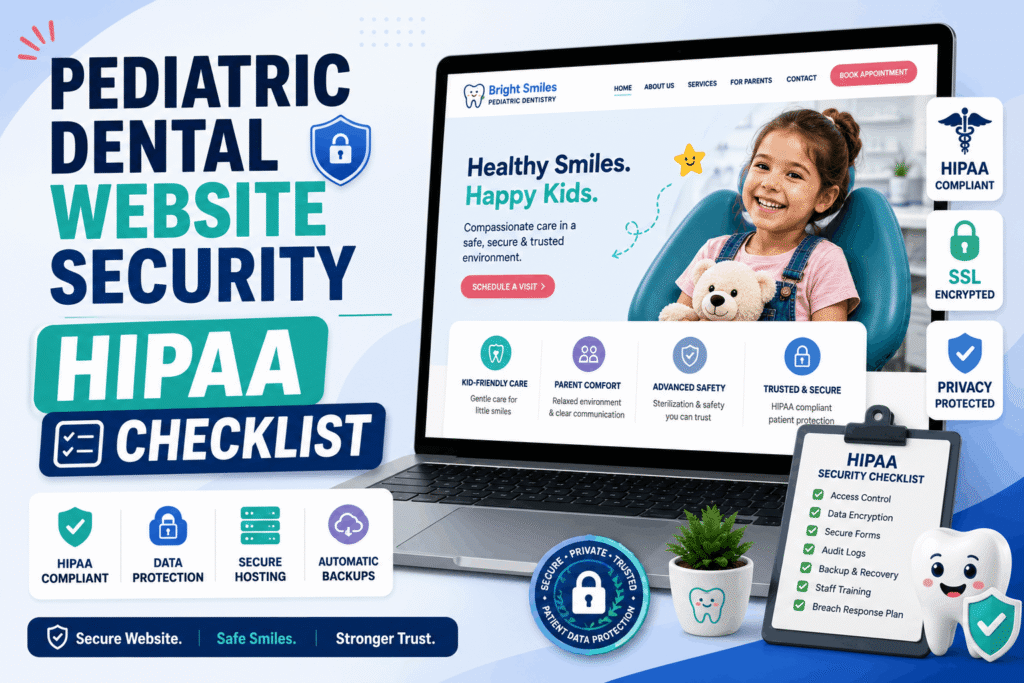
Most web development agencies treat security as an afterthought, often stopping at a basic Let’s Encrypt SSL certificate and a generic security plugin. When managing a standard marketing brochure, that might suffice. However, when operating a pediatric dental practice website that handles protected health information (PHI)—such as children’s medical histories, parent contact info, and appointment requests—standard security measures are an outright liability.
Failing to secure your practice’s digital perimeter can result in severe financial penalties, data leaks, and a total loss of community trust. A true, patient-winning website requires a secure, high-density architecture engineered from the ground up to isolate data, secure intake pipelines, and maintain compliance. This technical guide breaks down the full-stack infrastructure required to safeguard your pediatric dental platform.
1. The Core Infrastructure: Secure Web Architectures
True security begins at the server and architectural level. Many modern platforms rely heavily on external Content Delivery Networks (CDNs) and dozens of third-party scripts to render basic styles and components. While convenient, this opens up massive supply-chain vulnerabilities, exposing your platform to cross-site scripting (XSS) and malicious code injection.
The solution is a zero-dependency frontend execution framework. Compiling styles locally using command-line utilities—such as compiling utility-first CSS assets straight out of a local main style file—ensures the code contains zero malicious third-party scripts. Furthermore, configuring strict HTTP Security Headers forces browsers to interact with your server via secure protocols exclusively.
| Security Vector | Standard Web Configuration | HIPAA-Conscious Architecture |
|---|---|---|
| Data Transmission | Basic HTTPS encryption with weak or outdated TLS versions. | Enforced TLS 1.3 with Perfect Forward Secrecy (PFS). |
| Form Handling | Data stored plainly in a local database or sent via standard unencrypted email. | End-to-end tokenized transmission directly to encrypted storage vaults via secure APIs. |
| Frontend Dependencies | Heavy reliance on multi-source public CDNs and tracking tags. | Locally pre-compiled runtime frameworks with strict Content Security Policies (CSP). |
2. Securing Data in Transit: Encrypted Onboarding Pipelines
When a parent submits a pre-screening intake form for their toddler, that data enters a phase called “data in transit.” If your form processor uses standard, unencrypted protocols, that sensitive configuration can be easily intercepted. Standard email is entirely insecure; sending patient names, birthdates, or dental concerns via traditional server relay functions violates regulatory guidelines.
To eliminate this vulnerability, the platform must use tokenized, asynchronous API handlers to send form data. The intake payload must be immediately scrubbed of special characters to prevent SQL injection attacks, encrypted at the application level, and safely tunneled to an isolated database or a specialized practice management integration via secure webhooks. Below is a conceptual example of a hardened, clean form submission method running on the server backend:
public function processSecureIntake() {
    $rawName = $_POST['parent_name'] ?? '';
    $rawMobile = $_POST['mobile_number'] ?? '';

    $cleanName = preg_replace('/[^a-zA-Z\s]/', '', $rawName);
    $cleanMobile = preg_replace('/[^0-9]/', '', $rawMobile);

    if (empty($cleanName) || strlen($cleanMobile) < 10) {
        return json_encode(['status' => 'error', 'message' => 'Invalid Request']);
    }

    $securePayload = $this->encryptionLibrary->lockData([
        'name' => $cleanName,
        'phone' => $cleanMobile
    ]);

    return $this->apiGateway->forwardToVault($securePayload);
}
3. Data at Rest: Hardening the Database Environment
Once patient information reaches its destination, it becomes “data at rest.” Storing health insurance numbers or medical history notes in plaintext within a standard database table invites catastrophe. If a malicious actor breaches the hosting account, they gain access to everything.
Maintaining a secure platform requires database-level column encryption using advanced standards such as AES-256. Cryptographic keys must never be stored on the same server as the database itself. Instead, manage them through dedicated key vault services, ensuring that even if the primary server environment is compromised, the data remains unreadable without the decryption key.
“Data breaches in the healthcare sector reached an all-time high recently, with the average cost of recovery surpassing millions of dollars per incident. Proactive full-stack engineering is no longer an option—it is a baseline business requirement.”
4. Restricting Client-Side Interactions & Scraping Vectors
Security also extends to protecting your intellectual property, custom visual components, and team assets from malicious extraction or automated scraping bots. Competitors often use simple scrapers to download custom clinic imagery or clone code structures.
To protect your frontend digital assets, deploy obfuscated scripts to completely block unauthorized mouse interactions, disable context menus, prevent drag-and-drop operations on custom photography, and neutralize keyboard shortcuts like F12 or Inspect Element. While no frontend barrier is completely bulletproof against a highly determined attack, creating high technical friction successfully deters automated scrapers and low-level asset copying, keeping your proprietary clinic assets safe.
5. Automated Asset Performance and Performance Optimization
Security controls must never degrade performance. A slow website creates user frustration, forcing parents to abandon the page and seek care elsewhere. Furthermore, slow load speeds directly damage search visibility on Google.
Your technical workflow should include automated asset build steps. All graphic assets must undergo systematic server-side conversion into highly efficient WebP formats, maintaining excellent visual clarity while drastically reducing file sizes. When combined with localized CSS frameworks that prune unused selectors automatically, the resulting page passes Google Core Web Vitals effortlessly, turning clean engineering into a massive competitive advantage.
Partner with an Expert Full-Stack Technical Team
Building an authoritative digital portal for a specialized clinic requires a deep familiarity with high-end, functional system logic. A generic website build cannot protect your practice or deliver the fluid, high data-density user experience required to compete at the highest tier.
At Perosite, we reject standard visual templates to build highly advanced, lightning-fast solutions from the ground up. Our specialized team handles everything from local compilation workflows to robust database hardening. Explore our specialized solutions for custom pediatric dental website design to build a fast, secure, and fully compliant platform for your practice.
Ready to upgrade your practice infrastructure with a secure patient-generation engine? Contact us today to receive a comprehensive technical website audit and development quote.