The Post-Click Era: The Shift to Answer Engines
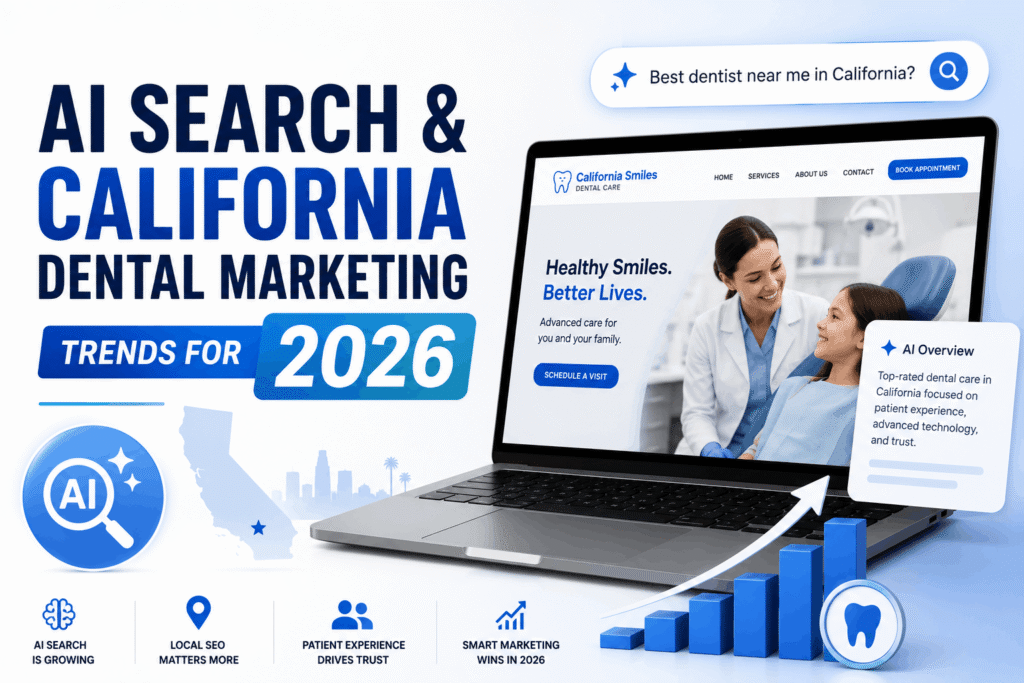
The digital marketing playbooks that dental practices relied on for the last decade are rapidly becoming obsolete. We have officially entered the era of the “zero-click search.” In the highly competitive California market, tech-savvy parents and prospective patients are no longer just looking at a standard list of blue website links on a Google results page. Instead, they are asking complex questions directly to Generative AI engines, seeking instant, synthesized summaries.
When a user queries an AI interface for the “best pediatric dentist in San Jose who accepts delta dental and specializes in anxious children,” the engine does not scrape random keywords. It evaluates deep data networks, technical structures, and local authority to recommend a select few clinics. To remain visible, your practice website must transition into an optimized data node that AI algorithms can easily read, trust, and extract.
Alongside the rise of AI search, California healthcare practices are facing an unprecedented surge in digital accessibility lawsuits. Future-proofing your practice requires an aggressive convergence of advanced semantic data structuring and bulletproof accessibility architectures.
1. Optimizing for AI Retrieval: Semantic Schema Architectures
Large Language Models (LLMs) and search assistants do not read web content the way humans do. They look for explicit, verified semantic connections within the underlying source code. If your website code relies on messy template tags, an AI engine will bypass your platform entirely.
To ensure AI search overviews recommend your clinic, your backend must deploy highly detailed JSON-LD (JavaScript Object Notation for Linked Data) schema markup. This means going far beyond basic local business tags to implement highly specialized medical and FAQ schemas.
- MedicalBusiness Schema: Explicitly defines your exact clinical specialties, medical certifications, accepted insurance networks, and geographic operating boundaries.
- FAQPage Schema: Formats common patient inquiries in precise question-and-answer pairs, allowing AI models to pull your expert answers directly into search overviews.
- DefinedTerm Schema: Maps specific clinical treatments (like dental sealants or interceptive orthodontics) directly to authoritative medical definitions, proving your website’s structural authority.
| Optimization Vector | Traditional SEO Approach | 2026 AI Engine Optimization |
|---|---|---|
| Content Strategy | Keyword stuffing and repetitive localized meta tags. | Topical completeness, deep question-answering architecture, and verified entity relationships. |
| Data Structure | Basic header hierarchy (H1, H2, H3) within raw HTML text. | Deep, nested JSON-LD schema packages explicitly declaring medical credentials and network data. |
| Performance Metric | Desktop speed rendering and manual desktop browser validation. | Strict mobile-first Core Web Vitals compliance ensuring immediate accessibility by automated web crawlers. |
2. The Legal Imperative: Bulletproof ADA Compliance in California
While AI optimization dictates your visibility, website accessibility dictates your legal safety. California is the absolute epicenter of digital accessibility lawsuits under Title III of the Americans with Disabilities Act (ADA) and the Unruh Civil Rights Act. Plaintiff law firms systematically scan healthcare websites using automated tools, seeking easy targets for predatory litigation.
If your dental website cannot be fully navigated by a screen reader or via keyboard-only controls, your practice faces catastrophic legal liabilities. Layering a cheap, third-party accessibility widget or overlay on top of an inherently broken template does not protect you; in fact, recent court rulings indicate that these overlays often serve as a beacon for litigants by highlighting an underlying lack of native compliance.
True Compliance Requirements: Accessibility must be baked directly into the core programming architecture. This requires strict adherence to the Web Content Accessibility Guidelines (WCAG 2.2 AA standard):
- Ensure all interactive elements have explicit, programmatic
aria-labeltags. - Maintain high color contrast ratios across all textual elements to ensure readability under variable lighting.
- Guarantee all visual assets feature comprehensive alternative text descriptions (alt text) embedded directly in the media data.
- Structure the frontend navigation tab order so screen readers can smoothly navigate intake forms without getting trapped in infinite loops.
3. Content Completeness and E-E-A-T
AI search models are trained to evaluate content based on four core pillars: Experience, Expertise, Authoritativeness, and Trustworthiness (E-E-A-T). Thin, AI-generated blog posts that offer generic advice provide zero value to search models. To rank highly, your content must show unmistakable signs of real clinical authority.
Every treatment page must be highly detailed and exhaustive. For example, rather than simply stating that your clinic offers pediatric sedation, your content should explicitly outline the exact types of sedation used, the monitoring equipment present in the room, the pre-appointment fasting guidelines for parents, and the emergency safety training your clinical staff undergoes. This deep level of data density satisfies both anxious parents and the information retrieval thresholds of modern search engines.
Ensure your practice is ready for the future of search. Discover our technical dental website design california solutions to build a highly visible, legally compliant digital asset.
4. Streamlining Frontend Performance for AI Indexing Bots
AI engine crawlers require immense computational power to scrape, parse, and understand the web. Consequently, these bots prioritize indexing sites that render instantly and consume minimal crawling budget. If your server response time is slow due to bloated backend plugins or massive unoptimized assets, indexing bots will abandon your platform, leading to dropped visibility.
To protect your crawl budget, your platform should utilize a zero-dependency frontend workflow. Compiling production styles locally via specialized CLI configurations removes external render-blocking scripts entirely. When paired with automated server-side workflows that systematically compress visual assets into next-generation WebP formats, your website achieves the extreme speed required for rapid indexing by modern search infrastructure.
Secure Your Competitive Advantage in the AI Era
The transformation of the digital marketing landscape presents a massive opportunity for forward-thinking clinics. While legacy practices continue to rely on outdated, insecure templates that face constant compliance risks, you can gain a significant competitive edge by investing in modern technical web infrastructure.
Building a platform that seamlessly balances advanced JSON-LD data architectures, native WCAG accessibility compliance, and lightning-fast execution requires deep full-stack engineering expertise. Transitioning away from basic layouts to a fluid, high data-density environment ensures your practice remains highly visible, legally protected, and engineered for long-term growth.
Ready to future-proof your clinic’s online presence? At Perosite, we engineer highly advanced, custom dental website design california solutions designed to outpace traditional SEO metrics and secure maximum patient conversions. Contact us today to receive a comprehensive technical website audit and operational deployment estimate.