Executive Summary: The Digital Imperative for the Manchester of India
Ludhiana, historically revered as the “Manchester of India,” stands at a critical juncture in its industrial evolution. For decades, this city has served as the backbone of India’s hosiery, textile, and light engineering sectors. However, the traditional methods of business acquisition—relying heavily on trade fairs, physical samples, and established offline networks—are rapidly facing obsolescence in the face of aggressive global competition from nations like China, Bangladesh, and Vietnam.1 As the global textile market is projected to reach US$1.61 trillion by 2033 3, the manufacturers of Ludhiana, particularly those situated in the dense industrial clusters of Focal Point, Industrial Area A, and Industrial Area B, must pivot towards a robust digital presence.
The economic landscape of Ludhiana is vast and varied, dominated by Micro, Small, and Medium Enterprises (MSMEs) that form the lifeblood of the state’s economy. From the spinning mills on Chandigarh Road to the intricate fastener manufacturing units in Miller Ganj, the city’s industrial output is staggering. The fastener industry alone comprises over 1,000 functional units with a turnover exceeding ₹1,500 Crores 4, while the knitwear sector commands a near-monopoly on winter wear production in India.5 Yet, despite this manufacturing prowess, the digital representation of these industries often lags behind global standards. A significant gap exists between the generic web services currently offered in the local market and the specialized, high-functionality platforms required by export-oriented manufacturers.6
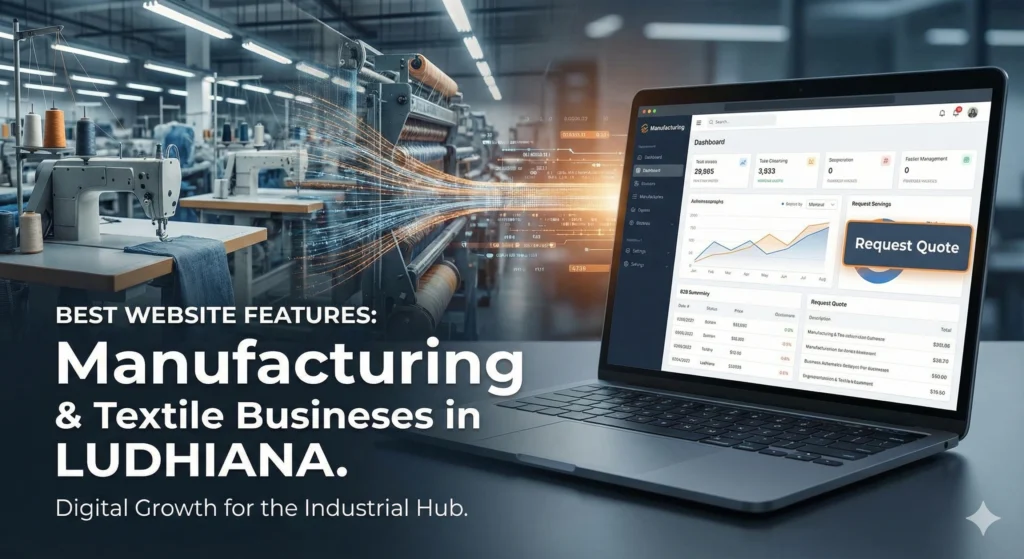
Most local digital solutions focus on basic brochure websites, whereas the current market demands high-functionality platforms capable of virtual sampling, automated request-for-quote (RFQ) processing, and international regulatory compliance.8 The integration of advanced web features is not merely an aesthetic upgrade but a functional necessity to bridge the distance between a loom in Ludhiana and a boutique buyer in Europe or a wholesaler in the United States. For business owners and stakeholders in the textile, cycle parts, and machine tool sectors, the website is no longer a digital business card; it is the primary engine for lead generation and brand authority.
This report outlines a comprehensive digital strategy, focusing on the essential website features, local SEO mechanics, and content architectures required to transform local manufacturing units into global export powerhouses. It provides an exhaustive roadmap for constructing high-authority digital assets, leveraging local competitive advantages, and mastering the nuances of search engine optimization (SEO) to dominate both local and international search results. In this context, partnering with a specialized web developer in Ludhiana becomes a strategic imperative to navigate the complexities of B2B digital transformation.
1. Analyzing the Ludhiana Industrial Landscape & Digital Maturity
1.1 The Economic Fabric of Ludhiana: Hosiery, Textiles, and Engineering
To understand the requisite digital features, one must first dissect the industrial DNA of the region. Ludhiana is home to a diverse array of industries, with a commanding dominance in woolen knitwear, where it accounts for approximately 95% of India’s production.5 The city hosts major corporate entities such as Vardhman Textiles, Trident Group, and Hero Cycles, which have set benchmarks in operational scale.10 However, the bedrock of the economy remains the thousands of MSMEs operating out of clusters like Focal Point (Phases 1-8), Gill Road, and the Mixed Industrial Areas.11
The operational reality of these businesses involves complex supply chains, B2B dependencies, and seasonal demand cycles. The knitwear sector, for instance, is heavily export-oriented, with significant markets in Europe and the Middle East, alongside emerging markets like Russia.13 This export-heavy focus dictates that a website serving a Ludhiana-based manufacturer must perform dual functions: it must act as a local anchor for recruitment and vendor management while simultaneously serving as a global storefront for international buyers who may never visit the physical factory.
The diversity of Ludhiana’s industry is also its strength. The fastener cluster, centered around the Fasteners Manufacturers Association of India, represents a highly specialized niche requiring technical precision in digital representation.4 Similarly, the cycle parts industry, with stalwarts like Hero Cycles and numerous ancillary units in Focal Point Phase 6, requires digital catalogs that can handle thousands of SKUs and complex specification sheets.11 The disparity between the manufacturing sophistication and the digital presentation is often stark. While a factory floor might utilize state-of-the-art CNC machines or computerized knitting technology 15, the company website often remains a static HTML page from the early 2000s.
1.2 The Current State of Digital Adoption in Ludhiana
Research into the local web development market indicates a proliferation of service providers, yet a standardization of service quality remains elusive. An analysis of top organic results for “Web Developer Ludhiana” reveals agencies like Vyapar Infotech, Khalsa Website Designers, and LAKSN Technologies dominating the landscape.6 These agencies emphasize generic value propositions such as “responsive design,” “SEO services,” and “ecommerce solutions”.17
However, a critical gap analysis suggests that few providers are explicitly marketing features tailored to the industrial nuances of the region. For example, while many agencies offer “e-commerce,” true B2B manufacturing requires “catalog mode” with bulk pricing tiers, not just a retail shopping cart. The disconnect is palpable; manufacturers struggle with labor shortages and rising competition 1, yet their digital platforms rarely address these pain points through features like automated recruitment portals or efficiency-driven client portals.
The market is flooded with low-cost packages, with some providers offering websites for as low as ₹3,800 to ₹5,000.19 While this lowers the barrier to entry, it often results in subpar digital assets that lack the necessary technical SEO foundation to rank globally. A cheap website might serve a local bakery well, but for a textile exporter aiming to attract clients from the European Union, a generic template lacks the requisite trust signals, security compliance, and performance optimization.
1.3 Competitor Benchmarking and SERP Analysis
The Search Engine Results Page (SERP) for Ludhiana-related web development queries is highly competitive but distinctively local. The “Local Pack” or “Map Pack” is heavily influenced by proximity and review density. Agencies like Flymedia Technology and DCS Web Solutions maintain visibility through high review counts and keyword-rich business descriptions.21
| Competitor | Primary Focus | Strengths | Weaknesses |
| Vyapar Infotech | General Web Development | Strong organic ranking, broad service range, emphasizes “B2B portal development” 6 | Generic messaging, lacks industry-specific case studies in snippets |
| Khalsa Website Designers | Web Design & SEO | Speed focus, “No. 1” claims, lifetime support 16 | Limited detail on B2B complex functionalities like ERP integration |
| LAKSN Technologies | Digital Solutions | Mention of specific industrial areas (Dugri, Focal Point), broad industry coverage 7 | Broad focus (apps, music styles) dilutes manufacturing expertise |
| Flymedia Technology | Design & Marketing | Large portfolio (4200+ projects), healthcare niche focus 22 | Heavy focus on healthcare may alienate heavy engineering clients |
| DCS Web Solutions | Web & Digital Marketing | Focus on lead generation and long-term growth 21 | Less emphasis on technical manufacturing features |
The analysis suggests that while generalist agencies abound, there is a distinct opportunity for manufacturing businesses to differentiate themselves by adopting a “specialist” digital posture. A textile manufacturer’s website that speaks the language of “GSM,” “fabric composition,” and “lead times” will inherently outperform a generic business site in terms of conversion and trust.
2. Strategic Website Architecture for Manufacturing & Textile Businesses
2.1 The B2B User Experience (UX): From Brochure to Business Tool
For a textile business in Ludhiana, the website must transition from a static digital brochure to a dynamic business tool. The primary user persona visiting these sites is a professional buyer—a sourcing agent from a European fashion house, a procurement manager from an automotive assembly plant, or a domestic wholesaler. Their search intent is transactional and informational; they need to verify capacity, certification, and quality assurance protocols efficiently.
The site architecture must prioritize Information Architecture (IA) that reduces friction. Unlike B2C sites where the goal is impulse buying, B2B sites must facilitate rational, data-driven decision-making. Essential navigation elements should include:
- Product Catalog (Non-Transactional): A detailed, searchable database of products (e.g., “Fasteners,” “Woolen Cardigans,” “Auto Parts”) organized by category and specification rather than price. This catalog should support filtering by material, dimensions, and compliance standards.
- Infrastructure & Capacity: A dedicated section showcasing factory floor capabilities, machinery (e.g., CNC machines, circular knitting machines), and daily production limits. This acts as a trust signal for high-volume orders, assuring the buyer that the manufacturer can meet delivery schedules.
- Compliance & Certifications: A prominent repository for ISO 9001, SA8000, and environmental compliance certificates, which are non-negotiable for Western buyers.9
2.2 Designing for the “Industrial” Aesthetic
The visual language of a manufacturing website differs significantly from consumer retail. It must convey robustness, precision, and scale. High-quality industrial photography is paramount. Utilizing drone footage of the expansive facilities in Focal Point or high-resolution close-ups of textile textures can bridge the physical gap between the buyer and the manufacturer.
However, aesthetics must not compromise performance. With international buyers accessing sites from various global locations, Core Web Vitals—specifically Largest Contentful Paint (LCP) and Cumulative Layout Shift (CLS)—must be optimized. A slow-loading heavy-media site will result in high bounce rates from international regions with varying internet speeds. Common web design mistakes in the manufacturing sector, such as cluttered layouts or “full-width” issues where the site does not scale to modern monitor sizes, must be rigorously avoided.24
2.3 Mobile Responsiveness in a B2B Context
While B2B transactions often conclude on desktops, the initial research phase increasingly occurs on mobile devices. A sourcing agent at a trade show might look up a Ludhiana supplier on their smartphone. Therefore, the website must be fully responsive, ensuring that complex data tables (e.g., screw specifications or fabric yarn counts) remain readable on smaller screens without breaking the layout.7
Many manufacturing sites fail here, presenting tables that require horizontal scrolling or text that is too small to read. Implementing responsive data tables, where columns stack or become collapsible on mobile, is a critical feature that differentiates a professional exporter from a novice.
3. Critical Website Features for Export-Oriented Manufacturers
3.1 Virtual Showrooms and 360-Degree Product Views
The post-pandemic era has accelerated the adoption of virtual showrooms. For Ludhiana’s textile industry, where tactile feel and drape are crucial, digital proxies such as 360-degree product photography and virtual tours are game-changers.8
- Implementation: Utilizing platforms like Matterport or specialized WordPress plugins (e.g., SR Product 360° View) allows manufacturers to create immersive walkthroughs of their sample rooms.26
- Strategic Value: A virtual showroom allows a buyer in London to “walk” through a collection in Ludhiana, viewing garments from every angle, zooming in on stitching details, and visualizing the product in a 3D space. This significantly reduces the time and cost associated with sending physical samples.28
- Integration: These tours should be embedded directly into the “Products” or “Showroom” section of the site, accessible via a simple login to capture lead data (gatekeeping the highest value content can qualify leads).
3.2 Automated Request for Quote (RFQ) Systems
Unlike B2C retail where prices are fixed, B2B manufacturing pricing is dynamic, based on volume, material costs (e.g., yarn prices), and customization. Therefore, a standard “Add to Cart” button is often inappropriate.
- The Feature: An intelligent RFQ system where buyers can select products, specify quantities, upload technical drawings or tech-packs, and submit a consolidated inquiry.
- Mechanism: This system should integrate with the company’s CRM or ERP, sending immediate acknowledgments to the buyer and alerting the sales team. It replaces the inefficient back-and-forth of email threads with a structured data intake process.25
- Customization: The form should be dynamic, asking different questions based on the product category selected (e.g., “Fabric GSM” for textiles vs. “Tensile Strength” for fasteners).
3.3 Export Documentation and Compliance Hub
To position a Ludhiana business as a serious exporter, the website must proactively address the administrative burdens of international trade.
- HS Code Integration: Product pages should clearly list the Harmonized System (HS) codes, helping buyers estimate import duties in their respective countries.9
- Certifications Display: A dedicated footer or sidebar widget should display active memberships with bodies like the Federation of Indian Export Organisations (FIEO), Apparel Export Promotion Council (AEPC), and local entities like the Chamber of Industrial & Commercial Undertakings (CICU).30 This validates the company’s legitimacy and adherence to labor and quality standards.
- Logistics Information: Information regarding proximity to Inland Container Depots (ICDs) and dry ports in Ludhiana (e.g., Dhandari Kalan) reassures buyers about the logistical feasibility of shipping large orders.3
3.4 Multi-Lingual Capabilities and International SEO
With key export markets in Russia, Europe, and the Middle East 13, a monolingual English site restricts market penetration.
- Hreflang Implementation: Implementing
hreflangtags ensures that a user in Russia sees the Russian version of the site, while a user in Germany sees the German version. This is a critical technical SEO signal that prevents duplicate content issues and improves local ranking in target countries.32 - Content Localization: Beyond mere translation, content should be localized. For instance, sizing charts should be toggleable between UK, US, and EU standards. Currency converters (for reference only) can also enhance the user experience.
- Market-Specific Landing Pages: Creating specific pages targeting high-priority regions (e.g., “Woolen Knitwear Supplier for Russian Market”) allows for targeted SEO campaigns that address specific regional needs and compliance standards.
4. Hyper-Local SEO Strategy: Dominating the Ludhiana Market
4.1 Keyword Strategy: LSI and Local Intent
Ranking for “Web Developer Ludhiana” or “Textile Manufacturer Ludhiana” requires a nuanced understanding of Latent Semantic Indexing (LSI) keywords. These are conceptually related terms that help search engines understand the content’s context.33
- Primary Keywords: “Textile Manufacturer in Ludhiana,” “Hosiery Exporters India,” “Custom Cycle Parts Ludhiana.”
- LSI Keywords: “Circular knitting capacity,” “CNC machining services Punjab,” “Focal Point industrial area,” “Woolen garment suppliers,” “Export quality knitwear,” “Dyeing units Ludhiana.”
- Strategy: These keywords must be woven naturally into H2 and H3 headers, product descriptions, and the “About Us” narrative. Avoid keyword stuffing; instead, focus on topical authority. For example, discussing “circular knitting” naturally leads to mentioning machine gauges and fabric types, which are all LSI terms relevant to the textile industry.
4.2 Leveraging Local Landmarks and Geo-Targeting
To signal strong local relevance to Google, the website content must reference specific geographical markers associated with Ludhiana’s industrial identity.
- Pin Code Targeting: Content should explicitly mention key industrial pin codes such as 141003 (Industrial Area A, Miller Ganj), 141010 (Focal Point), and 141014 (Dhandari Khurd).35 These pin codes are strong geo-signals.
- Landmark References: Mentioning proximity to landmarks like “Near Cheema Chowk,” “Gill Road Industrial Belt,” “Sherpur Chowk,” or “Chandigarh Road” in the “Contact” or “Location” pages helps Google map the business’s physical relevance to user searches in those vicinities.11
- Embedded Maps: Embed a Google Map pointing to the factory location, ideally verified through a Google Business Profile (GBP). Ensure the map includes driving directions from major hubs like the Ludhiana Railway Station or Sahnewal Airport.
4.3 Google Business Profile (GBP) Optimization
For a local manufacturing business, the GBP is the digital front door.
- Category Selection: Choosing the correct primary category is vital. Options include “Fabric product manufacturer,” “Exporter,” “Textile Mill,” “Machine Shop,” or “Industrial Equipment Supplier”.38 Incorrect categorization can severely limit visibility.
- NAP Consistency: The Name, Address, and Phone number (NAP) must be identical across the website, GBP, and all directory listings (Justdial, IndiaMART). Any discrepancy (e.g., “Phase 5” vs. “Phase-V”) can dilute local authority and confuse search engine algorithms.40
- Reviews & Q&A: Actively soliciting reviews from suppliers and partners builds trust. The Q&A section can be used to pre-emptively answer common queries about factory timings, visiting protocols, and parking availability for heavy vehicles.
4.4 Schema Markup for Manufacturing
Structured data (Schema markup) allows search engines to “read” the website’s data more effectively, leading to rich snippets in search results.
LocalBusiness&ManufacturingPlant: Use the specificManufacturingPlantschema type to define the business nature. Include properties likeopeningHours,address, andtelephone.41 This tells Google explicitly that the entity is a factory, not a retail store.ProductSchema: Wrap individual items in the catalog withProductschema, detailingname,image,brand, andsku. Even without a price, this helps products appear in Google Images and Shopping surfaces.43OrganizationSchema: Use this to link social profiles (sameAs) and define the corporate structure, which is helpful for groups with multiple subsidiaries (e.g., a group with both spinning and garmenting units).44
5. Content Strategy: Building EEAT (Experience, Expertise, Authoritativeness, Trustworthiness)
5.1 Demonstrating Expertise through Technical Content
In the B2B sector, content must demonstrate deep technical expertise to satisfy E-E-A-T guidelines. A blog post titled “How we make sweaters” is too generic and low-value. Instead, content should address complex industry challenges that show the manufacturer knows their trade inside out.
- Topics: “Navigating Yarn Price Fluctuations in 2026,” “The Impact of Sustainable Dyeing Processes on Export Compliance,” “Understanding GSM Variations in Circular Knits,” “Precision Machining for Auto Components: Meeting German Standards.”
- Authorship: Articles should be attributed to subject matter experts within the company (e.g., “Written by the Chief Technical Officer” or “Insights from the Production Manager”) to bolster E-E-A-T signals. This attribution should link to author bios that highlight their years of experience in the Ludhiana industry.
5.2 Building Authority with Association Backlinks
Authority is heavily influenced by the quality of inbound links. Ludhiana businesses have a unique advantage due to the strong network of local industrial associations.
- Strategy: Secure backlinks from high-authority domains such as the Fasteners Manufacturers Association of India (fastenerindia.org) 14, Ludhiana Knitwear Club (knitsandwears.com) 46, and CICU (cicuindia.org).30
- Execution: This can be achieved by ensuring the business is listed in their member directories, sponsoring association events, or contributing technical articles to their newsletters.47 These links are contextually relevant and carry significant weight in the eyes of search engines.
5.3 Trust Signals: Case Studies and Portfolios
Nothing builds trust like proven success. The website should feature detailed case studies that go beyond simple image galleries.
- Structure: Follow a “Challenge-Solution-Result” format. “Problem (e.g., Client needed 50,000 units in 3 weeks) -> Solution (Leveraged night shifts and automated cutting) -> Result (Delivered on time with 0.5% rejection rate).”
- Privacy: If client names cannot be disclosed (common in white-label manufacturing), use descriptors like “A leading European High-Street Brand” or “A Major US Auto-Part Retailer.”
- Visual Proof: Include photos of the specific production run, quality control reports, and packed shipments ready for export.
6. Financial Considerations: Cost vs. Investment in Web Development
6.1 Analyzing the Local Pricing Ecosystem
The cost of web development in Ludhiana varies drastically, creating confusion for business owners. It is crucial to understand what different price points deliver.
- Low-End Market (₹3,800 – ₹8,000): Local freelancers and budget agencies often offer packages in this range.19 These are typically static, template-based sites with shared hosting. They lack SEO foundation, security features, and custom functionality. They are suitable for small trading firms but inadequate for manufacturing exporters.
- Mid-Range (₹15,000 – ₹40,000): Standard corporate websites fall into this bracket. These usually include responsive design, basic CMS integration (WordPress), and some level of content optimization.17
- High-End Custom Solutions (₹1,00,000 – ₹4,00,000+): For a robust B2B portal with RFQ systems, virtual showrooms, API integrations with ERPs, and multi-lingual support, investments are significantly higher.19 This reflects the complexity of backend development and custom frontend design.
6.2 The ROI of Quality Development
For a textile exporter, a website is a capital asset, much like a knitting machine or a CNC lathe. If a ₹2,00,000 website generates even one export order worth $50,000, the ROI is immediate. Conversely, a cheap, slow-loading site that fails to load product images for a buyer in New York represents a massive opportunity cost. Business owners must view this expense through the lens of “Digital Infrastructure” rather than “IT Overhead.” A high-quality site works 24/7, acting as a global sales representative that never sleeps.
7. Selecting the Right Web Development Partner in Ludhiana
7.1 Evaluating Local Agencies
When choosing a partner, manufacturers should look beyond the price tag and evaluate capability.
- Portfolio Relevance: Does the agency have experience with industrial clients? Have they built sites for other manufacturers, or is their portfolio dominated by restaurants, gyms, and local services?.7 A developer who understands the difference between a “bolt” and a “screw” can better structure a catalog.
- SEO Capabilities: Can they demonstrate an understanding of B2B SEO? Do they know what Hreflang is? A developer who doesn’t understand SEO will build a site that looks good but remains invisible to international buyers.
- Technical Proficiency: Ask about their technology stack. Are they using bloated themes that slow down the site, or are they building custom, lightweight solutions? Do they offer maintenance packages to keep the site secure?.6
7.2 The Role of Specialized Consultants
For complex projects, generalist agencies might lack the strategic vision. Engaging a specialized web developer in Ludhiana who understands the intersection of code, SEO, and manufacturing logic is often the most prudent path. Such experts can architect a solution that is not just a website, but a digital extension of the factory floor, integrating with inventory systems and providing real-time data to clients.
8. Navigating the Future: Trends Impacting Ludhiana’s Digital Landscape
8.1 AI and Automation in Web Interfaces
Artificial Intelligence is beginning to permeate the web development space. For Ludhiana’s manufacturers, AI chatbots can provide 24/7 customer service, answering basic queries about MOQs, lead times, and shipping terms in multiple languages, bridging time zone gaps. These bots can be trained on the company’s specific product data, providing accurate and instant responses to international inquiries.
8.2 Sustainability Reporting
As global markets tighten regulations on carbon footprints, websites will increasingly need to host dynamic “Sustainability Dashboards.” These dashboards can show real-time or verified data on water usage, energy consumption, and recycling efforts. For Ludhiana’s dyeing and processing units, which face scrutiny over environmental impact, transparently displaying compliance with Zero Liquid Discharge (ZLD) norms can be a primary differentiator in securing contracts with global brands that prioritize ESG (Environmental, Social, and Governance) criteria.
9. Comprehensive Competitor & Gap Analysis for Ludhiana
9.1 The Competitive Landscape
The digital landscape for “Web Developer Ludhiana” is fiercely contested. The organic results are dominated by agencies that have mastered local SEO for themselves, but often fail to apply the same rigor to their industrial clients.
- Vyapar Infotech 6: Positions itself as the “best” with a focus on awards and team size. Their content is keyword-heavy but somewhat generic, lacking specific case studies on industrial problem-solving.
- Khalsa Website Designers 16: Focuses on speed and “proven SEO results,” appealing to the performance-conscious client but offering limited detail on complex B2B integrations.
- Webcreations 50: Uses strong social proof and testimonials, highlighting their ability to take clients from page 2 to page 1, but their own site may lack the modern industrial aesthetic required by export houses.
9.2 The “Content Gap”
While these agencies rank well, their content often targets the generic business owner. There is a massive content gap for “Industrial Web Design.” Very few agencies discuss:
- How to integrate ERPs with websites for real-time stock visibility.
- Secure client login portals for tracking order status and shipment documentation.
- Digital catalog management for thousands of SKUs with complex parent-child variations.This gap represents a prime opportunity for a new or pivoting agency—or a forward-thinking manufacturer—to capture the market by addressing these specific technical needs.
10. Conclusion: The Digital Roadmap for 2026 and Beyond
For the industrialists of Ludhiana, the path forward is clear. The era of relying solely on reputation and trade directories is fading. The new marketplace is digital, global, and ruthlessly efficient. To thrive, manufacturing and textile businesses must invest in digital platforms that reflect their operational excellence.
This requires a website that is:
- Discoverable: Optimized for local and international search intents using advanced SEO strategies.
- Credible: Laden with trust signals, certifications, and high-quality visuals that convey scale and quality.
- Functional: Equipped with tools like RFQ systems, virtual showrooms, and client portals that facilitate business transactions.
By embracing these strategies and partnering with capable experts—such as a dedicated web developer in Ludhiana—Ludhiana’s businesses can ensure that the “Manchester of India” remains a global industrial titan well into the digital age.
Detailed Strategic Breakdown
Section A: Local SEO & Keyword Implementation Guide
To execute the strategy outlined above, businesses must adopt a rigorous approach to Local SEO. The following table outlines the key “Money Keywords” and their corresponding content targets.
| Keyword Category | Target Keywords | Content Destination |
| Primary (Head) | Web Developer Ludhiana, Website Design Ludhiana, SEO Company Ludhiana | Home Page, Service Main Page |
| Industry Specific | Textile Website Design, Manufacturing Web Solutions, Industrial Marketing Agency | Industry Vertical Pages (e.g., “For Textiles”) |
| Location Specific | Web Design Focal Point, SEO Services Gill Road, Digital Agency Industrial Area A | Location Landing Pages / Footer Links |
| Long-Tail Intent | Best website features for exporters, B2B catalog web design cost, Virtual showroom developer Ludhiana | Blog Posts / FAQ Sections |
Section B: Technical Implementation of Schema Markup
For a manufacturing plant in Ludhiana, the following JSON-LD code snippet illustrates the correct implementation of ManufacturingPlant schema. This should be placed in the <head> section of the homepage.
JSON
<script type="application/ld+json">
{
  "@context": "https://schema.org",
  "@type": "ManufacturingPlant",
  "name": "Ludhiana Textile Works",
  "image": "https://www.example.com/images/factory-floor.jpg",
  "url": "https://www.example.com",
  "telephone": "+91-161-XXXXXXX",
  "address": {
    "@type": "PostalAddress",
    "streetAddress": "Plot No. 123, Industrial Area A",
    "addressLocality": "Ludhiana",
    "addressRegion": "Punjab",
    "postalCode": "141003",
    "addressCountry": "IN"
  },
  "geo": {
    "@type": "GeoCoordinates",
    "latitude": 30.9010,
    "longitude": 75.8573
  },
  "openingHoursSpecification": {
    "@type": "OpeningHoursSpecification",
    "dayOfWeek":,
    "opens": "09:00",
    "closes": "18:00"
  },
  "sameAs": [
    "https://www.facebook.com/ludhianatextileworks",
    "https://twitter.com/ludhianatextile",
    "https://www.linkedin.com/company/ludhiana-textile-works"
  ]
}
</script>
Section C: Content Calendar for Authority Building
To build sustained organic traffic, a consistent content output is necessary. Below is a suggested 3-month content calendar tailored for a Ludhiana textile manufacturer.
- Month 1: Trust & Capability
- Week 1: “5 Reasons Why Ludhiana is the Global Hub for Woolen Knitwear.” (Targeting international awareness)
- Week 3: “Virtual Tour: Inside Our Focal Point Manufacturing Facility.” (Showcasing infrastructure)
- Month 2: Technical Expertise
- Week 1: “Understanding HS Codes for Importing Textiles from India.” (Helpful content for buyers)
- Week 3: “Cotton vs. Synthetic: Choosing the Right Blend for Winter 2026.” (Product expertise)
- Month 3: Local Dominance
- Week 1: “Our Contribution to the Ludhiana Green Industry Initiative.” (CSR & Local relevance)
- Week 3: “Case Study: delivering 10k Units to a German Retailer in Record Time.” (Social Proof)
Section D: The Role of Google Maps & Local Pack
The “Local Pack”—the map listings that appear at the top of Google search results—is often the first point of interaction. For industrial businesses in areas like Dhandari Khurd or Sahnewal, appearing here is crucial for logistics partners and visiting buyers.
- Optimization Tactic: Ensure that the map pin is perfectly accurate. In industrial estates, roads are often confusing. A misplaced pin can lead to frustrated truck drivers and missed meetings.
- Photo Updates: Regularly upload photos of the factory exterior, signage, and team. Google’s vision AI analyzes these images to understand the business context.
Section E: Analyzing the “Money Page” Strategy
The integration of a specialized service page, such as https://perosite.com/web-developer-in-ludhiana/, serves as a conversion anchor.
- Anchor Text Strategy: Using anchors like “expert web development services in Ludhiana” signals relevance to search engines without looking spammy.
- Contextual Placement: This link should be placed in sections discussing high-level strategy or technical implementation, positioning the service provider as the solution to the complex problems discussed in the report.
Deep Dive: The Ludhiana Advantage & Digital Transformation
The Historical Context and Modern Necessity
Ludhiana’s journey from a small town to an industrial colossus is a testament to entrepreneurial spirit. However, the modern “Industrial Revolution 4.0” is digital. The textile industry, in particular, faces a dual challenge: rising raw material costs and the need for speed-to-market. Digital tools reduce the “time to showcase.” A website with a virtual showroom reduces the sales cycle from weeks (sending physical samples) to minutes (digital review). This efficiency is what will define the next generation of Ludhiana’s market leaders.
Overcoming the “Traditional Mindset”
One of the biggest hurdles in Ludhiana is the traditional mindset where business is done “face-to-face.” While this builds strong relationships, it is not scalable globally. A website does not replace the relationship; it initiates it. It is the handshake before the meeting. Educating the local older generation of industrialists on this nuance is the primary task of any web developer in Ludhiana.
The Export-Import Dynamics
Ludhiana is a significant inland container depot (ICD) hub. The website should reflect this logistical capability. Information about proximity to dry ports, relationships with freight forwarders, and packaging standards (e.g., palletization for EU export) creates immense confidence in foreign buyers who worry about the logistics of sourcing from the Indian hinterland.