
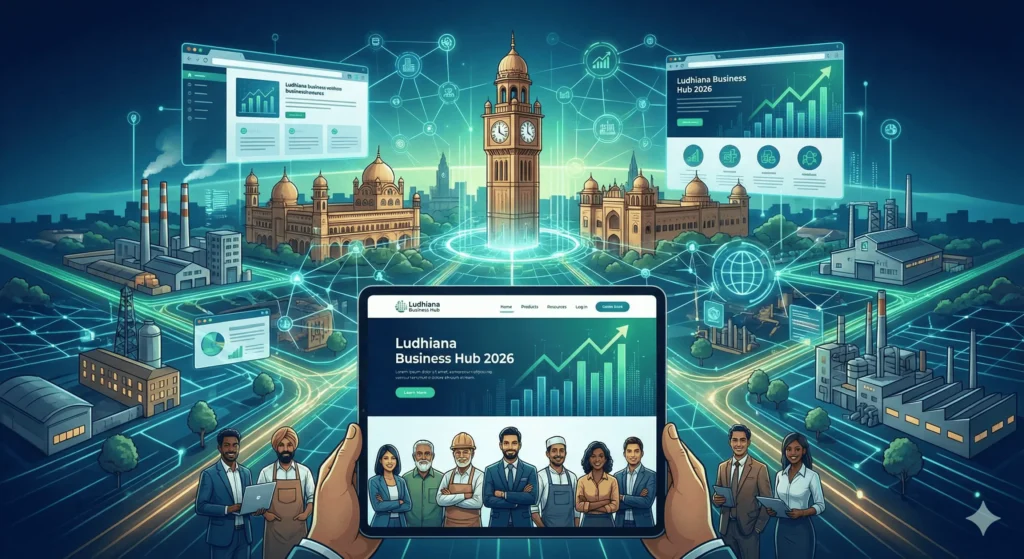
1. Executive Introduction: The Industrial Pivot of 2026
The year 2026 marks a definitive inflection point for the industrial clusters of Ludhiana. Long revered as the “Manchester of India,” this bustling metropolis in Punjab has historically thrived on a foundation of tangible assets: heavy machinery, skilled labor in the hosiery mills, and the relentless entrepreneurial spirit of the “Lala” culture. However, the economic topography of 2026 is fundamentally different from the preceding decades. The digital transformation that was once a buzzword has calcified into an absolute operational requirement. The convergence of hyper-localized digital connectivity, the maturity of Artificial Intelligence (AI) in consumer applications, and a tectonic shift in global supply chain dynamics has rendered traditional business models not just inefficient, but obsolete.
This report posits a central thesis: for the Small and Medium Enterprises (SMEs) and large conglomerates of Ludhiana, the ownership of a professional, custom-developed website is no longer a marketing luxury—it is the central nervous system of modern enterprise. The evidence, drawn from extensive analysis of Tier-2 city digital adoption, telecommunications saturation in Punjab, and the volatility of third-party platforms, suggests that the transition from “rented” digital presence to “owned” digital sovereignty is the defining challenge of this decade.
As we analyze the landscape, we see that the demand for digital maturity is driven by a sophisticated consumer base. Reports indicate that India’s data center capacity has more than doubled in 2025, with Tier-2 cities contributing significantly to digital infrastructure absorption. This is not merely an infrastructural statistic; it is a proxy for the digitization of the local economy. The consumer in Ludhiana, empowered by ubiquitous 5G connectivity and affordable smartphones, now demands a digital experience that mirrors the efficiency of global e-commerce giants. Local businesses that fail to meet this expectation with a robust, professional web developer in Ludhiana-architected presence risk invisibility in a marketplace that has become entirely screen-mediated.
1.1 The Macro-Economic Shift to Tier-2 Innovation
The narrative of Indian economic growth has decisively shifted away from the saturated metros of Mumbai and Delhi toward dynamic Tier-2 hubs. By 2026, cities like Ludhiana are no longer just manufacturing back-offices but are emerging as the launchpads for global-scale ideas. The growth of Global Capability Centers (GCCs) in these regions has expanded the local talent base to over 82,000 professionals, creating a demographic that is digitally native and culturally aspirational.
This demographic shift has profound implications for local consumption. The “Great Indian Belly”—the expanding middle class—is driving demand for high-quality goods and services. Data reveals that 45% of total demand for international lifestyle brands now originates from Tier-2 and Tier-3 cities. This presents a paradox for Ludhiana’s local manufacturers: while they produce world-class goods, their local customers are increasingly turning to digital channels to purchase international brands that offer superior online experiences. A professional website acts as the necessary counter-measure, a digital flagship that signals quality, reliability, and modernity to a discerning customer base that refuses to engage with outdated, non-responsive digital interfaces.
2. The Infrastructure of Connectivity: Punjab in the Digital Age
To understand the urgency of website adoption, one must first appreciate the digital terrain of Punjab in 2026. The state has achieved a level of telecommunications saturation that makes “offline” customers a statistical anomaly.
2.1 Tele-density and the Always-On Consumer
As of 2025, Punjab exhibits exceptionally high mobile penetration metrics. Urban centers like Chandigarh and Ludhiana show saturation levels where the number of connected devices often exceeds the population, indicating a multi-device environment. The urban tele-density has reached 131.45%, a figure that underscores the ubiquity of internet access. Private access service providers hold over 92% of the market share, driving a hyper-competitive environment that ensures affordable high-speed data for the masses.
For a business owner in Ludhiana, these statistics translate to a simple reality: your customer is always online. Whether they are a procurement manager at a bicycle factory on Gill Road or a fashion enthusiast in Model Town, their primary window to the world is a 6-inch smartphone screen. In this high-bandwidth environment, the tolerance for friction is zero. A business relying on a slow-loading directory listing or a static social media page is failing to leverage the 5G capabilities that their customers use daily. A professional website, optimized for Core Web Vitals and mobile responsiveness, is the only vessel capable of delivering the rich, interactive experiences that 2026 users expect.
2.2 The Data Center Boom and Local Latency
The surge in digital infrastructure is not just about consumer access; it is about enterprise capability. India’s data center capacity is projected to triple by 2030, with 2025 seeing a 103% year-on-year increase in capacity additions. This massive investment in digital plumbing means that hosting high-performance, data-intensive websites is more accessible and affordable than ever before. Local businesses can now deploy sophisticated ERP integrations, real-time inventory tracking, and high-definition video content without worrying about latency or bandwidth bottlenecks. The infrastructure is ready; the question remains whether Ludhiana’s businesses are ready to utilize it.
3. The Crisis of “Rented Land”: The Collapse of Platform Dependency
For nearly two decades, the digital strategy of many Ludhiana businesses was synonymous with listing on B2B marketplaces like IndiaMART or TradeIndia, or maintaining a Facebook page. In 2026, this “rented land” strategy has become fraught with existential risk. The platforms that once served as aggregators have evolved into gatekeepers, extracting higher rents while diminishing the value provided to the individual seller.
3.1 The IndiaMART and Marketplace Dilemma
The reliance on B2B marketplaces has reached a tipping point. By 2025, manufacturers across India have begun to voice severe dissatisfaction with the “shared lead” model employed by these platforms. In this model, a single inquiry from a buyer is sold to multiple sellers simultaneously, triggering a race to the bottom on price that erodes margins for everyone involved.
| Feature | Professional Website | B2B Marketplace (e.g., IndiaMART) |
| Lead Ownership | Exclusive: 100% of inquiries belong to you. | Shared: Inquiries sold to 5-10 competitors. |
| Data Transparency | High: Full analytics on visitor behavior. | Opaque: Platform hides visitor data. |
| Brand Equity | High: Custom design reflects brand identity. | Low: Standardized templates commoditize your brand. |
| Customer Retention | High: Direct re-marketing and email integration. | Low: Platform controls the communication channel. |
| Operational Risk | Low: You own the domain and hosting. | High: Accounts/Images deleted without warning. |
The operational risks are stark. Reports from 2025 highlight instances where platforms like IndiaMART have deleted product images without warning due to arbitrary policy changes regarding contact information, effectively sabotaging a seller’s catalog overnight. Furthermore, the shift toward hiding visitor data and forcing businesses to pay for “BuyLeads”—which are often low-quality or irrelevant—has transformed these platforms from partners into exploiters.
In this hostile environment, a business without its own website is a tenant with no rights. They do not own their customer relationships; the platform does. A professional website restores digital sovereignty. It ensures that when a potential buyer views a product, that interaction is a private, exclusive event between the buyer and the seller. It allows for the installation of proprietary analytics tools that provide deep insights into buyer behavior—data that platforms currently hoard or sell back to the business at a premium.
3.2 The Social Media Volatility Trap
Similarly, the reliance on social media giants like Meta (Facebook/Instagram) exposes businesses to algorithmic volatility. In 2026, organic reach on these platforms has plummeted to near-zero levels; they are strictly “pay-to-play” environments. A sudden policy change, an automated account ban, or a platform-wide outage can erase a business’s entire digital footprint in seconds.
The “content noise” on these platforms is deafening. A meticulously crafted post about a new textile weave is sandwiched between viral entertainment clips, diluting its impact. A professional website serves as a sanctuary from this noise—a controlled environment where the business dictates the narrative, the visual hierarchy, and the user journey without algorithmic interference.
4. Sector-Specific Deep Dive: The Bicycle Industry
Ludhiana produces 90% of India’s bicycles, a staggering statistic that cements its status as the industry’s capital. However, volume does not equate to value. In 2026, the industry faces severe headwinds: exports are lagging behind competitors like China, and the “commodity trap” threatens to squeeze margins. The path forward requires a radical digital reinvention.
4.1 Bypassing the Middleman and Tariff Barriers
The traditional export model for Ludhiana’s bicycle manufacturers relies heavily on buying agents and trade fairs. This model is inefficient and opaque. However, the geopolitical landscape of 2026 offers a unique opportunity. With the European Union continuing to enforce anti-dumping tariffs on Chinese e-bikes, a window has opened for Indian manufacturers to fill the void.
To exploit this, manufacturers must establish direct digital channels. A professional corporate website serves as a 24/7 global trade expo. It allows a component manufacturer in Focal Point to showcase their products directly to a procurement officer in Germany or the Netherlands. By presenting high-definition 3D models of components, downloadable CAD files, and virtual factory tours, a website can bridge the “trust gap” that often hinders international B2B relationships. This direct-to-buyer approach bypasses the commission-hungry agents and allows Ludhiana’s manufacturers to capture the full value of their export contracts.
4.2 The R&D Visibility Gap
Industry leaders have consistently flagged the lack of state-of-the-art R&D facilities as a bottleneck for global competitiveness. However, even where innovation exists—such as in the development of alloy frames or advanced transmission systems—it is often poorly communicated to the world. A generic marketplace listing cannot convey engineering prowess.
A custom-developed website allows manufacturers to publish white papers, detailed technical specifications, and case studies of their engineering challenges and solutions. This content marketing strategy positions a Ludhiana-based manufacturer not just as a supplier of cheap parts, but as a sophisticated engineering partner. For example, a website can feature a dedicated “Innovation Hub” section that details the stress-testing protocols, material certifications, and compliance with ISO standards. This transparency is crucial for winning high-value contracts in regulated markets like the EU and North America.
4.3 Case Study: The Hero Cycles Trajectory
The evolution of Hero Cycles provides a blueprint for the industry. From a modest component maker in 1956, Hero has grown into a global giant with a production capacity of 7.5 million units. Their success is not just built on manufacturing scale but on a robust digital and brand presence that transcends the “commodity” label. Hero’s digital ecosystem allows them to manage a network of 2,800 dealerships and capture data on consumer preferences across 70 countries. For smaller SMEs in Ludhiana, the lesson is clear: you may not have Hero’s scale, but with a professional website, you can project a similar level of professionalism and accessibility to the global market.
5. Sector-Specific Deep Dive: Textiles and Hosiery
The textile sector, another pillar of Ludhiana’s economy, is navigating a tumultuous period. Exports of textiles from Punjab saw a sharp decline of nearly 30% between 2021 and 2024, driven by fierce competition from Bangladesh and Vietnam. To arrest this decline and find new growth avenues, the industry must pivot from low-margin contract manufacturing to high-margin Direct-to-Consumer (D2C) brand building.
5.1 The D2C Imperative: From “Lala” to Brand
The shift from family-run businesses to professionally managed organizations is already underway. The second generation of business leaders understands that in 2026, brand equity is synonymous with digital equity. Reliance on white-label manufacturing leaves Ludhiana’s mills vulnerable to price wars they cannot win against nations with lower labor costs.
Developing a proprietary D2C channel via a professional website allows manufacturers to capture the full retail margin. As seen with the success of niche platforms like Woolenwear.in, there is a specific, untapped demand for Ludhiana’s winter wear products. However, succeeding in D2C requires more than just a shopping cart; it demands a sophisticated e-commerce architecture.
- Inventory Synchronization: A professional site can integrate directly with the factory’s ERP, ensuring that the stock levels shown online match the physical inventory in the warehouse.
- Personalization: AI-driven recommendation engines can suggest products based on a user’s past browsing behavior, increasing the average order value.
- Returns Management: A seamless, automated returns process builds consumer trust, a critical factor for online apparel sales.
5.2 Competing with Global Fast Fashion
Ludhiana’s manufacturers are no longer just competing with each other; they are competing with Zara, H&M, and Uniqlo. These global giants have set the consumer expectation for what a fashion buying experience should look like: high-resolution imagery, video lookbooks, detailed size guides, and user reviews. A template-based website or a Facebook page cannot deliver this experience. To compete, Ludhiana’s textile brands need custom websites that offer “Shoppable Video” interfaces, “Virtual Try-On” features using Augmented Reality (AR), and rich storytelling content that highlights the heritage and quality of Ludhiana’s wool. This narrative layer—explaining the difference between Merino and generic wool, for instance—is a competitive advantage that global fast-fashion brands cannot replicate with their generic product descriptions.
6. Sector-Specific Deep Dive: Machine Tools and Industrial Supply
For the industrial supply and machine tools sector in Ludhiana—concentrated in Industrial Area B—the purchasing journey has moved almost entirely online. The days of waiting for a catalog in the mail are over.
6.1 The Digital Procurement Journey
In 2026, B2B buyers conduct approximately 70% of their research online before they ever contact a sales representative. They are searching for specific machine capabilities, tolerance levels, power consumption data, and maintenance schedules. If a machine tool manufacturer does not have a website with detailed, searchable digital catalogs, they are eliminated from the consideration set before the first call is made.
A professional website for this sector serves as a Digital Technical Repository. It must house:
- Downloadable CAD/CAM Files: allowing engineers to test fitment virtually.
- Interactive Spec Sheets: that allow buyers to configure machine options and see real-time performance data.
- Video Demonstrations: High-quality videos showing the machinery in operation, providing proof of capability that static images cannot.
6.2 SEO for Industrial Keywords
The search behavior for industrial goods is highly specific. Buyers do not search for “Machine Tools.” They search for “Hydraulic Deep Drawing Press 500 Ton” or “CNC Vertical Machining Center for Auto Parts.” A generic website will not rank for these long-tail, high-intent keywords. A professional web developer in Ludhiana can structure the website’s hierarchy to target these specific technical terms, ensuring that the business appears exactly when a procurement manager is looking for their specific solution.
7. The Vernacular Voice Search Revolution
One of the most profound shifts in the 2026 digital landscape is the way users in Punjab interact with the internet. The era of typing English keywords is rapidly giving way to voice-based queries in regional languages.
7.1 The Rise of Punjabi Voice Search
Data indicates a staggering 270% growth in voice search adoption in India, with a projected market size of $974 million by 2030. Crucially, over 75% of internet users in India prefer content in regional languages. This is not just a rural phenomenon; it is a pervasive behavioral shift across all demographics. For a local business in Ludhiana, this means the customer is no longer typing “best hosiery manufacturer.” They are speaking into their phone in Punjabi or Hindi: “Ludhiana vich vadhiya woolen jacket kitho milu?” (Where can I get good woolen jackets in Ludhiana?) or “Gill road te cycle parts di wholesale dukaan” (Cycle parts wholesale shop on Gill Road).
7.2 The “Near Me” Economy and Hyper-Local SEO
Voice search is intrinsically linked to local intent. 58% of voice searches are for local business information. When a user asks a voice assistant for a service, the algorithm typically provides only one or two top answers—the “position zero” results. To capture this “Near Me” traffic, a website must be technically optimized for local SEO. This involves:
- Schema Markup: Implementing structured data code (JSON-LD) that explicitly tells search engines the business’s address, hours of operation, geo-coordinates, and service areas.
- Vernacular Content Strategy: Creating pages that are optimized not just for English keywords but for the phonetic transliterations of Punjabi and Hindi terms that users speak.
- Natural Language Optimization: Voice queries are conversational questions, not keyword strings. Content must be written in a natural, Q&A format that mirrors human speech patterns.
A basic, template-based website lacks the flexibility to implement these complex Schema structures and multilingual architectures effectively. This is a critical area where professional development expertise translates directly into foot traffic and sales.
8. The AI Integration Imperative
By 2026, Artificial Intelligence is no longer a futuristic concept; it is a standard operational tool for businesses of all sizes. However, AI requires a structured digital environment to function.
8.1 The Website as an AI Hub
The business landscape of 2026 rewards “Discipline, not Scale,” meaning efficiency is paramount. AI tools integrated into a website are the key drivers of this efficiency.
- AI Chatbots and Virtual Assistants: In 2026, customers expect 24/7 support. An AI agent integrated into a professional website can handle complex inquiries—such as checking the stock status of a specific bicycle rim or explaining the washing instructions for a merino wool sweater—in real-time, even when the factory is closed.
- Predictive Personalization: AI can analyze the behavior of visitors on the website to dynamically adjust the content they see. If a visitor from Germany lands on a Ludhiana cycle parts website, the AI can automatically highlight export certifications, Euro-compliant models, and shipping terms to Hamburg. If a local retailer visits, the site highlights wholesale bulk deals and GST invoices.
8.2 Agentic AI and the “Answer Engine”
Search engines are evolving into “Answer Engines” powered by Agentic AI. These AI agents traverse the web to find solutions for users, rather than just providing a list of links. If a business’s data is locked inside a closed platform like Facebook or a poorly coded website, AI agents cannot parse it. A custom website with clean, semantic code ensures that these AI agents can “read” the business’s offerings and recommend them to users as the best solution. The website becomes the machine-readable interface of the business, allowing it to participate in the automated economy of the future.
9. Technical SEO: The Engine Under the Hood
In the face of these sophisticated demands, the “Do-It-Yourself” (DIY) website builders (like Wix or Squarespace) often fail to deliver the required technical performance.
9.1 Core Web Vitals and Performance
In 2026, Google’s ranking algorithms place immense weight on “Page Experience” signals, collectively known as Core Web Vitals. These metrics measure loading speed (LCP), interactivity (INP), and visual stability (CLS). Despite the rollout of 5G, internet connectivity in industrial zones can still be inconsistent. A professionally developed website is optimized at the code level. Developers use techniques like “tree-shaking” to remove unused code, implement next-generation image formats (AVIF/WebP), and set up advanced caching strategies. This ensures the site loads instantly, preventing the high bounce rates associated with slow DIY templates.
9.2 Security in a Zero-Trust World
As SMEs digitize, they become prime targets for cyberattacks. A compromised website can destroy a manufacturer’s reputation and lead to the theft of sensitive customer data. Professional web developers implement “Zero Trust” security architectures. This involves secure API gateways, regular automated vulnerability scans, and strict content security policies (CSP). Security is not a plugin; it is an architectural decision that must be made at the development stage.
9.3 Progressive Web Apps (PWAs)
For local businesses, the distinction between a website and an app is blurring. A professional developer can build a Progressive Web App (PWA). This technology allows the website to function like a native app on a user’s phone—offering offline access to catalogs, sending push notifications for new stock arrivals, and sitting as an icon on the home screen—all without the high cost and friction of developing and maintaining a separate mobile app. This is particularly effective for Ludhiana’s wholesale traders who want to keep their network of retailers updated on daily rates and inventory.
10. The Strategic Roadmap: Building the Digital Asset
For a business in Ludhiana to survive the transition to the 2026 digital economy, a passive digital presence is insufficient. The website must be viewed as a capital asset, similar to high-precision machinery or prime real estate in Focal Point.
10.1 The Cost of Inaction
The cost of not having a professional website is the opportunity cost of invisibility. As 75% of local searches move to voice , and B2B buyers shift 70% of their journey online, the business that remains invisible is effectively ceding its market share to competitors who have adapted. The “Lala” culture of relying on legacy networks is rapidly depreciating in value.
10.2 The Role of Professional Expertise
Implementing this level of digital sophistication—voice search optimization, AI integration, PWA functionality, and high-security architecture—is beyond the scope of a generalist IT worker or a DIY tool. It requires a partner who understands both the global technology landscape and the specific nuances of the Ludhiana market. Engaging a professional web developer in Ludhiana ensures that the digital strategy is tailored to the region’s unique industrial ecosystem. A local expert understands the seasonality of the hosiery business, the technical specifications of the cycle industry, and the linguistic diversity of the Punjabi consumer.
10.3 Conclusion: The Digital Sovereign
The “Manchester of India” was built on hard work, engineering prowess, and an indomitable entrepreneurial spirit. In 2026, that spirit must be digitized. The era of the digital middleman is ending; the era of the digital sovereign is beginning. For the bicycle exporters, the hosiery giants, and the machine tool innovators of Ludhiana, a professional website is the flag they plant in the global digital economy—a declaration that they are open for business, on their own terms, to the world.
11. Appendix: Detailed Sector Analysis Tables
11.1 Comparative Analysis of Digital Channels for Ludhiana SMEs
| Channel | Reach | Control | Data Ownership | Cost Structure | Suitability for 2026 |
| B2B Marketplace | High (Initial) | Low | None | High (Subscription + Leads) | Declining: Good for discovery, poor for retention. |
| Social Media | High (Potential) | Very Low | None | Variable (Ad Spend Dependent) | Volatile: Essential for awareness, risky as a foundation. |
| DIY Website | Low | Medium | High | Low | Inadequate: Lacks technical SEO for voice/AI. |
| Professional Custom Site | High (Organic) | High | Full | Medium (Upfront Investment) | Essential: The only sovereign asset. |
11.2 The Technical Stack for a 2026 Industrial Website
To achieve the goals outlined in this report, a Ludhiana business website in 2026 requires a specific technical stack.
- Frontend: React.js or Next.js for lightning-fast rendering and PWA capabilities.
- CMS: Headless WordPress or Strapi to allow content to be pushed to multiple channels (Web, Voice, App) simultaneously.
- E-commerce Engine: WooCommerce (customized) or Shopify Plus for robust inventory management.
- Search: Elasticsearch or Algolia to allow B2B buyers to search for products by technical specifications (e.g., “Steel Grade 304”).
- Analytics: Google Analytics 4 (configured for custom events) + Microsoft Clarity for heatmapping user behavior.
- Security: Cloudflare Enterprise for DDoS protection and WAF (Web Application Firewall).
This technical rigor is what separates a business that “has a website” from a business that “runs on digital.” The investment in this stack is an investment in the future viability of the enterprise.